
Crossbelt Magnets – Design, Function, and Sizing Criteria
A comprehensive technical guide to crossbelt magnets. Learn everything about how they work, differences between permanent and electromagnets, installation, and optimal design for recycling plants.
Summary
Crossbelt Magnet – Short Definition
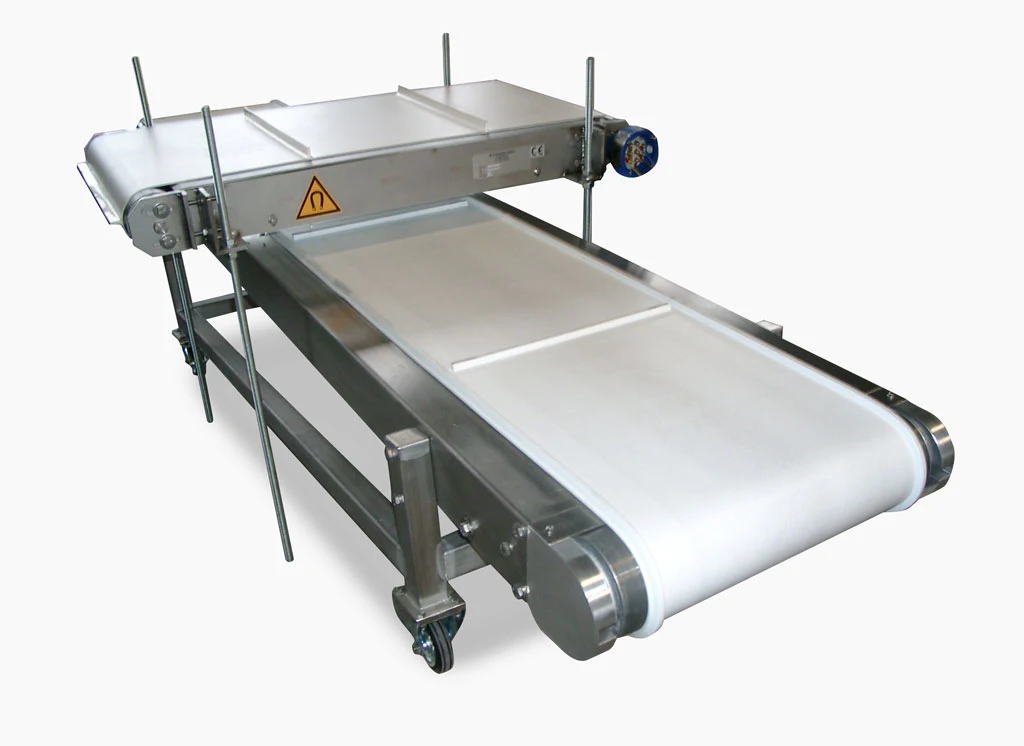
A crossbelt magnet is a magnetic separator installed at a defined distance, known as the suspension height, above a belt conveyor. It works against gravity: The magnetic field must be strong enough to pull magnetic parts upward from the material flow to the magnet. Unlike simple plate magnets that must be cleaned manually, they usually have a circulating discharge belt with cleats that transports the attracted iron parts out of the magnetic zone and discharges them into a collection container. Therefore, it is referred to as a self-cleaning magnetic unit.
Abhängehöhe
The suspension height is the vertical distance between the bottom of the magnet housing or the magnet belt and the conveyor belt. This parameter is crucial for design, as doubling the distance often requires quadrupling the magnet power. The suspension height is determined by the bed height of the material on the conveyor belt plus a safety distance of about 100 millimeters.
History and Development
Their development began with increasing industrialization and the need for automated sorting and separation processes. The first units were developed in the 1950s as the recycling industry began to professionalize. Initially, simple permanent magnets were installed over conveyor belts, but they had to be cleaned manually. The introduction of self-cleaning systems with circulating discharge belts in the 1960s revolutionized their use. With the development of strong neodymium magnets in the 1980s, they could be built more compactly while achieving higher working heights. Electromagnetic versions were developed in the 1970s for mining applications where extremely high working heights and switchable fields were required. Today, they are a standard component in nearly all recycling and sorting plants worldwide.
How It Works and Lifting Physics
The technical challenge is the depth penetration of the magnetic field
While a tube magnet has direct contact with the product, the unit must bridge an air gap, also called air gap, and often a thick material layer. This requires a particularly strong and deeply penetrating magnetic field. The physics of lifting is based on the interplay of various forces that must all be considered to ensure successful separation.
Force Relationships
For an iron piece, also called Fe particle, to be lifted from the conveyor flow, the magnetic attraction force must be greater than the sum of the opposing forces:
Fₘ > Fg + FMaterial + FinertiaWobei:
- F_m: Magnetic attraction force
- F_g: Weight force of the iron piece
- F_Material: Resistance from the overlying bulk material
- F_Trägheit: Kinetic energy of the conveyor flow
The weight force of the iron piece is directly proportional to its volume and material density. The resistance from the overlying bulk is particularly problematic with thick material layers, as the iron piece must burrow through debris or waste. The kinetic energy of the conveyor flow is determined by the belt speed. At high speeds over 2.5 meters per second, the magnet must be significantly stronger dimensioned to compensate for the relative speed. The magnetic attraction force decreases with the square of the distance, meaning that doubling the suspension height requires quadrupling the magnetic field strength.
Separation Process Steps
Activation
The conveyor material passes under the magnet. The material is evenly distributed on the conveyor belt, where the bed height is a critical parameter. Bed heights that are too thick can significantly reduce separation performance.
Pick-up (Lifting)
Ferromagnetic parts are captured by the field lines, vertically accelerated, and pulled to the belt of the crossbelt magnet. This process occurs against gravity and therefore requires a particularly strong magnetic field. The lifting speed depends on the magnetic field strength, field gradient, and size of the iron piece.
Transport
The circulating discharge belt with cleats pushes the held parts crosswise or lengthwise to the conveying direction. The cleats are crucial for reliable discharge, as they prevent the iron parts from slipping back on the belt. Worn cleats can significantly reduce discharge performance.
Discharge
Once the parts leave the active area of the magnet block, i.e., behind the magnet core, the magnetic holding force drops, and the parts fall into a scrap container. The discharge position must be chosen so that the parts safely enter the container without falling back onto the conveyor belt.
Depth Penetration and Field Gradient
The depth penetration of the magnetic field is crucial for the performance of the unit. While flux density can be measured at the magnet surface, the field strength in the depth of the material is critical for practical use. The field gradient describes how quickly the magnetic field strength decreases with increasing distance. A steep gradient means the field weakens quickly, which is problematic for separating particles at greater distances. Electromagnetic versions generate a deeper and more uniform field than permanent magnets, making them predestined for larger working heights.
Types: Permanent vs. Electro
The most important distinction lies in the generation of the magnetic field
There are two main types that fundamentally differ in the method of magnetic field generation. The choice between permanent and electromagnetic versions depends on numerous factors, including the required working height, operating costs, availability of electrical power, and maintenance requirements.
Permanent Crossbelt Magnet
In permanent crossbelt magnets, the magnet block consists of durable magnet materials, either ferrite or neodymium. These magnets generate a constant magnetic field without energy input.
- Design: Magnet system is static, while the belt frame is movable
- Advantages: No energy costs for the magnetic field, only for the belt drive motor; compact design; low maintenance; robust and long-lasting
- Disadvantages: Magnetic field not switchable, complicating cleaning during maintenance; limited depth penetration compared to electromagnets
- Use: Working heights up to approx. 400 mm; mobile crusher plants; wood recycling; standard recycling applications
Magnetmaterialien:
Ferrit: Ferrite magnets are cost-effective and robust but offer lower field strength. They are sufficient for most standard applications.
Neodym: Neodymium magnets provide higher field strength in a more compact design but are more expensive and temperature-sensitive.
Electro Crossbelt Magnet
In electro crossbelt magnets, the field is generated by coils fed with direct current. The coils can be oil- or air-cooled.
- Design: Oil- or air-cooled coil cores with complex winding
- Advantages: Extremely deep and strong magnetic field; switchable at the push of a button for easy maintenance; power often adjustable; suitable for very large working heights
- Disadvantages: High power consumption; high weight; cooling required; higher purchase and operating costs
- Use: Working heights over 400 mm up to 1000 mm; mining; coal power plants; scrap yards; applications with very high requirements
Comparison Table: Permanent vs. Electro
| Parameter | Permanent (Ferrite/Neodymium) | Electro (Oil/Air-Cooled) |
|---|---|---|
| Operating Costs | Very low (only belt drive) | High (coil current + drive) |
| Maintenance | Minimal, only belt and bearings | Medium (check oil level, cooling) |
| Capture Depth | Good for medium layers up to 400mm | Excellent for deep layers up to 1000mm |
| Switchability | No (mechanical device required) | Yes (push button) |
| Typical Width | 400 – 1600 mm | 800 – 2400 mm |
| Weight | Relatively light, compact | Very heavy, large dimensions |
| Energy Consumption | Only for belt drive (ca. 0.5-2 kW) | For coils and drive (5-50 kW depending on size) |
| Purchase Costs | Low to medium | High, often 3-5x higher than permanent |
Installation Types: Cross vs. Inline
Positioning is crucial for separation efficiency
The type of installation has a significant influence on separation efficiency. There are two main installation variants, each with pros and cons. The choice depends on the existing plant configuration, available space, and requirements for separation efficiency.
Cross Discharge (Cross-Belt)
The magnet is mounted at a 90-degree angle over the conveyor belt, transverse to the conveying direction.
Vorteile:
- Easy retrofitting into existing plants possible
- Lower space requirement in longitudinal direction
- Flexible positioning along the conveyor belt
Nachteile:
- Iron must be torn out against the material flow direction
- Higher resistance from the material layer
- Lower separation efficiency compared to inline discharge
Anwendungen:
Existing plants, limited space, retrofitting
Inline Discharge (Inline / Over-Head)
The magnet is mounted over the discharge drum, also called head pulley, in the conveying direction.
Vorteile:
- Material is in free fall (trajectory parabola), structure is loosened
- Minimal resistance from the loosened material structure
- Increased separation efficiency by 15-20% compared to cross discharge
- Better yield for heavy iron parts
Nachteile:
- Requires more space in the length of the plant
- Installation must be considered in planning
- Higher construction requirements
Anwendungen:
New plants, optimal separation efficiency required, high throughputs
Engineering tip: If possible, always choose inline installation over the head pulley, as the physics here, especially the loosening of the material in free fall, works in your favor. This can increase separation efficiency by 15 to 20 percent.
Application Areas in Detail
They are used in numerous industries
They are an indispensable part of modern recycling and sorting plants. Their application areas range from waste management to mining and machine protection. Each application places specific requirements on the design and construction of the unit.
Recycling & Waste Management (C&D Waste)
In recycling, they are standard. In sorting plants for construction site waste, they often hang over conveyor belts after the pre-crusher. The main task is recovering rebar and protecting downstream sorters like NIR sorters.
Anwendung:
Construction site waste, construction debris, mixed waste, household waste, commercial waste, demolition material
Anforderung:
Robust design for handling coarse and bulky materials. Long, bulky iron parts can catch in the belt, so magnet belt armoring is required. High throughput and wear-resistant components are essential.
Herausforderungen:
Various material sizes, high contamination, abrasive materials, varying material composition
Mobile Crusher Plants
In mobile jaw or impact crushers, a compact permanent version is usually integrated. These plants are used directly on construction sites and must therefore be particularly robust and vibration-resistant.
Anwendung:
Quarries, construction sites, demolition companies, recycling yards
Anforderung:
Extremely vibration-resistant, hydraulically driven, compact design, weatherproof. The magnet must withstand harsh site conditions and be easy to transport.
Herausforderungen:
Vibrations, dust, weather influences, frequent site changes
Mining & Coal
In mining, huge electro magnetic separators are used to remove tramp iron from coal or ore. This protects conveyor belts from being cut.
Anwendung:
Coal mining, ore processing, mineral processing, gravel and sand extraction
Anforderung:
Very large working heights, extremely high throughput, robust construction for heavy materials. Often electro crossbelt magnets with widths over 2000 mm are used.
Herausforderungen:
Extreme working heights, very high throughputs, heavy materials, continuous operation
Wood Recycling
In wood recycling, they are used to remove iron metals like nails, screws, and staples from wood waste. This is important for the quality of recycled wood and protecting downstream processing machines.
Anwendung:
Waste wood, pallets, construction timber, furniture recycling, particle board production
Anforderung:
Medium working heights, good separation for small iron parts like nails. Permanent crossbelt magnets are usually sufficient. The magnet must work reliably even with high wood content in the material flow.
Herausforderungen:
Small iron parts, high wood content, different wood types with varying properties
Incineration
In waste incineration plants, they are used to remove iron metals from bottom ash. This serves both material recovery and protecting downstream processes.
Anwendung:
Incinerator bottom ash, grate ash, filter ash
Anforderung:
Heat-resistant construction, robust design for abrasive materials, high throughput. Magnets must function reliably even at high temperatures.
Herausforderungen:
High temperatures, abrasive materials, various material sizes, high contamination
Scrap Yards and Metal Recycling
At scrap yards, large electromagnetic versions are used to sort and separate various metal types. This is a key step in metal recycling.
Anwendung:
Scrap processing, metal recycling, auto recycling, e-waste
Anforderung:
Very large working heights, high throughput, switchable fields for maintenance. Often multiple crossbelt magnets are used in series for optimal separation.
Herausforderungen:
Very large and heavy iron parts, high throughputs, various metals, complex material composition
Design & Technical Specifications
Proper design is crucial for application success
Designing these units requires considering numerous parameters. Incorrect design can lead to insufficient separation performance, increased operating costs, or even plant damage. The following parameters must be considered in specification.
Belt Width & Speed
The conveyor belt width determines the required magnet block width. An 800 mm wide belt usually requires a magnet block with at least 600 to 700 mm effective width. Belt speed is also critical: If the belt is faster than 2.5 m/s, the magnet must be stronger dimensioned to compensate for relative speed. At very high speeds, residence time in the magnetic field may be too short, reducing separation performance.
Bed Height & Suspension Height
This is the most important parameter in design. Bed height describes how high the material lies on the belt. Suspension height is the distance between conveyor belt and magnet belt. Rule of thumb: Suspension height = bed height + safety distance of about 100 mm. Doubling the suspension height often requires quadrupling magnet power, as magnetic force decreases with the square of distance.
Suspension height = Bed height + Safety distance (ca. 100mm)Particle Size & Iron Parts
The size of iron parts significantly influences required magnetic field strength. Large iron parts are easier to capture than small ones, as volume V in the force formula is directly proportional to magnetic force. Smaller particles under 10 mm require particularly strong magnets or special designs.
Beispiele:
- Large iron parts (over 50mm): Relatively easy to capture, even with weaker magnets
- Medium iron parts (10-50mm): Standard magnets sufficient
- Small iron parts (under 10mm): Strong magnets required, often neodymium
Environmental Conditions
Environmental conditions significantly influence the selection of the right crossbelt magnet. Dust, heat, moisture, or corrosive environments require special designs and materials.
Faktoren:
- Dust: Requires protected bearings and regular cleaning. ATEX-compliant versions required in dust explosion hazard areas.
- Heat: High temperatures can demagnetize permanent magnets. Special high-temperature magnets or electro crossbelt magnets required above 80°C.
- Moisture: Requires corrosion-resistant materials and protected electrical components.
- Abrasive environments: Requires wear-resistant belts, e.g., oil-resistant rubber or polyurethane scrapers.
Material Composition
The composition of the material to be processed significantly influences design. Different materials have varying densities and flow properties that must be considered.
Überlegungen:
- Material density: Heavy materials require stronger magnets
- Flow properties: Poor flow properties can lead to bridging
- Moisture content: Wet materials can stick to the belt
- Material mix: Mixed materials require robust design
Installation, Safety & Maintenance
Safety and regular maintenance are crucial for reliable operation
Installing these units requires careful planning and consideration of safety aspects. The unit generates a strong stray field that poses various safety risks. Additionally, the discharge belt requires regular maintenance for optimal performance.
Safety Zone
The unit generates a strong stray field extending beyond the immediate active area. This requires special safety measures.
- Pacemakers: Warning signs mandatory, as magnetic field can affect pacemakers. Minimum distance often over 1 meter.
- Tools: Do not leave wrenches or other ferromagnetic tools nearby – they become projectiles and can cause serious injuries.
- Substructure: Frame under the magnet should be non-magnetic steel, e.g., stainless steel 1.4301, to avoid diverting magnet power. Ferromagnetic materials nearby can short-circuit the field.
- Electronic devices: Smartphones, tablets, etc., should not be stored near the magnet.
- Personnel protection: During maintenance, magnetic field must be switched off for electro crossbelt magnets. Special safety precautions required for permanent magnets.
Discharge Belt Maintenance
The discharge belt is a wear part and requires regular maintenance for optimal discharge performance.
- Tracking: Belt must be regularly centered. Crowned drums help improve centering. Poor tracking can lead to belt run-off and increased wear.
- Cleats: Worn cleats significantly reduce discharge performance. Cleats should be regularly checked for wear and replaced if necessary. Modern belts have replaceable cleats.
- Lubrication: Roller bearings must be regularly greased. Permanent magnets otherwise require little maintenance, making them very service-friendly.
- Belt tension: Proper belt tension is crucial for reliable function. Loose belts can slip, tight belts lead to increased wear.
- Cleaning: Belt should be regularly cleaned to remove contamination affecting performance.
Electro Crossbelt Magnet Maintenance
Electro crossbelt magnets require additional maintenance compared to permanent magnets.
- Oil level: In oil-cooled systems, oil level must be regularly checked. Low oil can lead to overheating and damage.
- Cooling: Cooling systems must be regularly checked for function. Clogged cooling fins can significantly reduce cooling performance.
- Electrical components: Coils, cables, and connections must be regularly inspected for damage.
- Switch-off function: Switch-off function must be regularly tested to ensure magnetic field reliably deactivates.
Troubleshooting and Common Issues
Common problems and their solutions
Despite careful design and installation, problems can occur. Most problems have identifiable causes and can be resolved with appropriate measures.
Iron Not Discharged
If iron is not discharged from the magnet belt, various causes possible.
Lösungen:
- Discharge belt has no or worn cleats: Check and replace cleats if necessary
- Iron magnetically trapped on underside because magnet block extends too far into discharge zone: Check construction, adjustment possibly required
- For electromagnets: Switch-off not working: Check electrical components
- Belt tension too high: Adjust belt tension
Low Separation Performance
If separation performance is lower than expected, several factors may be the cause.
Lösungen:
- Suspension height too large: Reduce distance or use stronger magnet
- Belt speed too high: Reduce speed or use stronger magnet
- Bed height too large: Reduce material height or use multiple magnets in series
- Magnetic field strength too low: Use stronger magnet or increase power for electromagnets
Belt Tracking Issues
If belt does not run centered, can lead to increased wear and problems.
Lösungen:
- Drums not crowned: Check drums and adjust if necessary
- Belt tension incorrectly set: Adjust belt tension
- Dirty or damaged idlers: Clean or replace
- Substructure not aligned: Check and correct alignment
Comparison with Alternative Technologies
They are not the only technology for removing iron metals
There are various technologies for removing iron metals from material flows. Each has pros and cons, and often multiple technologies are combined for optimal separation.
Plate Magnets
Plate magnets installed under or in conveyor belts pull iron parts downward. Must be manually cleaned.
Vorteile:
Simple, cost-effective, no moving belt required
Nachteile:
Manual cleaning required, lower separation performance, not suitable for continuous processes
Drum Magnets
Drum magnets rotate around a stationary magnet core and continuously separate iron parts.
Vorteile:
Continuous separation, high efficiency, suitable for large throughputs
Nachteile:
More complex installation, moving parts require maintenance, higher costs
Eddy Current Separators
Eddy current separators use rotating magnets to capture non-magnetic but electrically conductive metals like aluminum and copper.
Vorteile:
Captures non-magnetic metals, high efficiency for conductive materials
Nachteile:
Only for conductive metals, higher energy consumption, more complex construction, often used in combination with crossbelt magnets
Economics and Cost-Benefit Analysis
Investment is generally very economical
Costs are generally low compared to potential damage from iron metals. A cost-benefit analysis should consider various factors including purchase costs, operating costs, maintenance costs, and savings potential.
Purchase Costs
Purchase costs vary greatly by type and size. Simple permanent crossbelt magnets start at about €5,000, while large electro crossbelt magnets can cost €50,000 or more. Size, required working height, and belt width are main cost factors.
Operating Costs
Permanent crossbelt magnets have very low operating costs, needing only power for belt drive, typically 0.5 to 2 kW. Electro crossbelt magnets have much higher operating costs due to coil power consumption, 5 to 50 kW depending on size.
Maintenance Costs
Maintenance costs for permanent crossbelt magnets are minimal, mainly for discharge belt. Electro crossbelt magnets incur additional costs for cooling systems and electrical components.
Savings Potential
Savings can be substantial: Protection of crushers and processing machines from iron metal damage, material recovery, reduction of downtime, and improved product quality. In recycling plants, savings from material recovery often amortize purchase costs within months.
Payback Period
The payback period is usually very short, often less than a year, especially in high-throughput recycling plants. Exact payback depends on application, throughput, and value of recovered materials.
Frequently Asked Questions
Answers to the most important questions about our products and their applications.
Need Help with Design?
Every application has specific requirements. Our engineers calculate the optimal crossbelt magnet for you, considering belt width, speed, bed height, material composition, and all other relevant factors. Contact us for free consultation.