
Plate Magnets – Robust Separation for Difficult Product Flows
A technical guide to plate magnets for bulk solids and conveying lines. Learn how they work, when wedge pole designs are useful, and how to select them for chutes, conveyor belts, bridging products, and abrasive media.
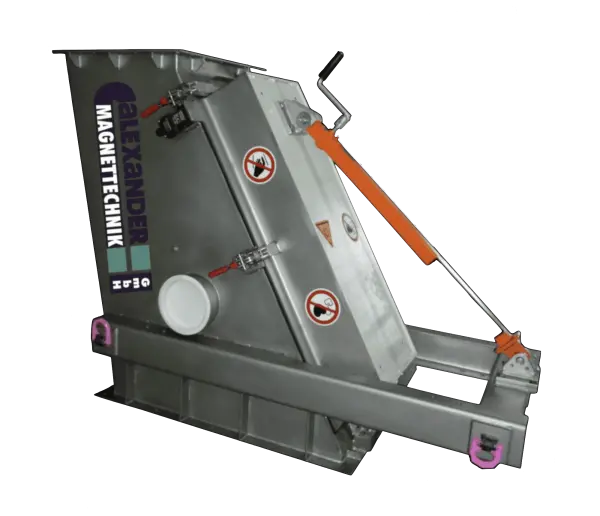
Plate Magnets for Industrial Bulk-Material Flows
Plate Magnet – Definition and Distinction
A plate magnet consists of a solid block of permanent magnetic material encased in a housing of ferromagnetic steel and covered on the product side with a wear-resistant stainless steel plate, often made of 1.4301 or 1.4404. It differs from other magnetic separators through its passive positioning: the plate forms part of a chute or conveyor-channel wall, or hangs statically over a conveyor belt. This means no moving parts and no obstacle in the product flow.
Passive Positionierung
The passive positioning makes it particularly suitable for applications where other magnetic separator types would fail. Integration into the wall creates no flow obstacles, which does not impair the material flow while enabling effective separation.
History and Development
Plate magnets have a long history in industrial applications. The first simple magnetic plates were already used in the early days of the industrial revolution when the need arose to remove iron particles from product flows. With the development of stronger permanent magnets, especially after the introduction of ferrite magnets in the 1950s, plate magnets became more cost-effective and widely available. The development of wedge pole technology in the 1970s revolutionized their use in chutes, as it effectively solved the wash-off effect problem. With the introduction of neodymium magnets in the 1980s, plate magnets could be built more compactly while achieving higher field strengths, making them suitable for separating fine particles and weakly magnetic materials. Today, they are a standard element in numerous industries, from food to recycling.
How It Works and Physics
The functional principle is based on generating a magnetic field that arches from the plate surface into the product flow
The functioning is based on generating a strong, inhomogeneous magnetic field that arches from the plate surface into the product flow. Ferromagnetic particles are attracted by this field and adhere to the plate surface, while non-magnetic material continues to flow. The efficiency of separation depends on several factors, including magnetic field strength, field gradient, product flow speed, and the magnetic properties of the particles to be captured.
The Magnetic Circuit
The back of the magnet block is glued to a steel plate that serves as a yoke and focuses the field lines on the front side, the active surface. This maximizes the holding force where the product flows. Without this yoke, the magnetic field would radiate evenly in all directions, significantly reducing efficiency.
The magnetic circuit works like an electrical circuit: The field lines run from the magnet's north pole through the air gap to the product, then through the ferromagnetic particles back to the south pole of the magnet, and finally through the yoke back to the north pole. This closed circuit maximizes the field strength at the active surface.
Interaction with Bulk Material
There are two primary mounting types that significantly influence the physics of separation:
Installation in Chutes (Chute Installation)
The material slides directly over the magnet plate. The magnetic force holds the iron particles on the surface while the non-magnetic material continues to slide. The critical factor here is the friction and the head pressure of the following material trying to rip the iron away. Wedge pole technology solves this problem by creating a flow-mechanical dead zone where the iron is protected.
Kritische Faktoren:
- Sliding speed of the material
- Friction coefficient between material and plate
- Head pressure of the following material
- Magnetic field strength and field gradient
Suspended Mounting (Suspension)
The plate hangs over a conveyor belt, similar to a crossbelt magnet but without a discharge belt. The critical factor here is that the magnetic force must overcome gravity plus the inertia of the moving material to lift the iron. This requires a particularly strong magnetic field, especially at high belt speeds.
Kritische Faktoren:
- Suspension height between plate and conveyor belt
- Belt speed
- Material bed height
- Magnetic field strength at depth
Force Relationships
For an iron piece to be successfully separated, the magnetic attraction force must be greater than the sum of the opposing forces:
Fₘ > Fg + Ffriction + Fdynamic pressure + FinertiaWobei:
- F_m: Magnetic attraction force
- F_g: Weight force of the iron piece
- F_Reibung: Friction force between material and plate
- F_Staudruck: Pressure force of the following material
- F_Trägheit: Inertia force of the moving material
The magnetic attraction force decreases with the square of the distance, while the opposing forces can increase linearly or even exponentially with speed and pressure. Therefore, it is important that the plate is positioned as close as possible to the product flow and that stronger magnets are used for high speeds or pressures.
Design Types: Smooth vs. Stepped (Wedge Pole)
A crucial detail for engineers is the profiling of the contact surface
The profiling of the contact surface, also called the pole surface, has a significant influence on separation efficiency and protection against wash-off effects. There are two main design types, each optimized for specific applications.
Smooth Design (Flush Face)
The stainless steel cover is completely flat, without protrusions or recesses.
Vorteile:
- Easy cleaning, no niches for product deposits
- Ideal for applications with extremely high hygiene requirements
- Suitable for suspended mounting over conveyor belts
Nachteile:
- In chutes, there is a risk that captured iron is carried away again by the product flow (wash-off effect)
- Lower separation performance at high throughputs
- Iron particles can be more easily ripped off
Anwendungen:
- Suspended mounting over conveyor belts
- Applications with extremely high hygiene requirements
- Food industry, where niches must be avoided
Design with Wedge Pole (Spout / Stepped Face)
The plate has one or two transverse steps, also called wedges. These steps create a flow-mechanical dead zone where the iron is protected.
Vorteile:
- The iron is attracted and slides against the step, where it lies in the magnetic shadow
- The following material flow slides over the step and the collected iron without ripping it loose
- Significantly higher separation performance in chute applications
- Protection against wash-off effects
Nachteile:
- Somewhat more difficult cleaning due to the step
- Can promote product deposits in the step (with poor cleaning)
- Not ideal for extremely high hygiene requirements
Anwendungen:
- Chute applications (industry standard)
- High throughputs
- Materials with high flow speed
- Applications where wash-off is a problem
For all chute applications, the wedge pole design is the industry standard. The step should be positioned in the flow direction to ensure maximum protection.
Magnet Materials Comparison
The choice of magnet material is crucial for the performance of the unit
There are various magnet materials used in plate magnets. Each material has specific properties that make it suitable for certain applications. The choice depends on factors such as required field strength, temperature resistance, costs, and the magnetic properties of the particles to be captured.
Comparison Table: Ferrite vs. Neodymium
| Property | Ferrite (Ceramic) | Neodymium (NdFeB) |
|---|---|---|
| Field Characteristics | Deep, far-reaching field | Short but extremely intense field |
| Target Particles | Large parts (screws, nuts, nails) | Fine iron, abrasion, weakly magnetic stainless steel |
| Temperature Resistance | Very good (up to approx. 250°C) | Limited (standard 80°C, high-temp up to 200°C) |
| Costs | Low | Medium to high |
| Typical Application | Mills, wood chips, coarse recycling | Food powders, plastic granules, pharma |
| Field Strength | 2,000 - 4,000 Gauss | 8,000 - 14,000 Gauss |
| Corrosion Resistance | Very good | Requires protection (encapsulation) |
Ferrit-Platten
Use ferrite plates to protect mills from destruction by large bolts. Ferrite plates are ideal for coarse iron and large particles where high field strength is not required. They are cost-effective, robust, and temperature-stable.
Neodym-Platten
Use neodymium plates at the goods outlet to ensure product purity. Neodymium plates are essential for fine iron, stainless steel abrasion, and weakly magnetic materials. They offer the highest available field strength and are therefore ideal for applications with the highest purity requirements.
Applications in Industrial Bulk-Material Flows
Plate magnets for bridging, abrasive or fast-moving materials
They are particularly suitable where internal obstructions would restrict a bulk-material flow. Flush mounting in chutes and conveyor channels supports free material flow and wear-resistant operation.
Problem Case 1: Bridging
Materials like wet flour, textile fibers, or wood chips can collect on internal obstructions and restrict the flow. This leads to production downtime and requires regular manual cleaning.
Lösung:
A plate magnet mounted flush in a chute or channel wall does not narrow the cross-section. Material can flow freely while ferromagnetic particles adhere to the plate.
Beispiele:
- Wet flour in mills
- Textile fibers in the textile industry
- Wood chips in recycling
- Sticky materials like honey or syrup
Problem Case 2: Abrasive Media
Glass cullet, corundum, or coarse ores subject components in the product flow to severe wear. This can lead to product contamination and frequent component replacement.
Lösung:
They have thick wear surfaces of 2 to 4 millimeters stainless steel or can be coated with manganese steel or Hardox. They last for years even with extremely abrasive materials.
Beispiele:
- Glass cullet in recycling
- Corundum in the abrasive industry
- Coarse ore in mining
- Sand and gravel in the construction materials industry
Problem Case 3: High Throughput
In large conveyor channels or at high conveying speeds, internal obstructions can slow the material flow. This reduces the production rate and can lead to uneven flow.
Lösung:
Flush-mounted plate magnets do not restrict the conveying rate and support high throughput with effective separation.
Beispiele:
- Large conveyor lines in the chemical industry
- High-speed conveyor belts
- Large chutes in recycling plants
- High-volume throughput in the food industry
Properties of Different Separation Concepts
| Criterion | Plate Magnet | Internal separation elements |
|---|---|---|
| Flow Resistance | No resistance, flush in wall | Resistance due to grid in flow |
| Clogging Risk | Very low, no bridging | High with bridging materials |
| Wear Resistance | Very high (2-4mm stainless steel) | Depends on design and material |
| Cleaning Effort | Medium (manual or Easy-Clean) | Low (Easy-Clean possible) |
| Costs | Medium | Low |
| Field Strength | High (due to yoke) | Very high (direct contact) |
| Installation | In wall or over belt | In product flow |
Installation and Cleaning
Proper installation and regular cleaning are crucial for efficiency
Installing these units requires careful planning and consideration of specific application requirements. Positioning has a significant influence on separation performance, and choosing the right cleaning method is important for ease of maintenance.
Installation Positions
There are various installation positions, each with its pros and cons:
At the Outlet of a Chute
The material falls over the edge of the magnet plate. Separation is most effective here, as the material is loosened and particles are more accessible.
Vorteile:
- Highest separation efficiency
- Material is loosened
- Lower head pressure
Nachteile:
- Requires space at the outlet
- May extend the chute
Below the Material Flow
The plate forms the bottom of the channel. The material flows directly over the plate, ensuring good contact time.
Vorteile:
- Good contact time
- Easy integration
- No additional length required
Nachteile:
- Higher head pressure
- Risk of wash-off at high speeds
In Rectangular Conveyor Chutes
Two plate magnets can be installed opposite each other in a rectangular conveyor chute to cover the full cross-section. This is also called a shaft magnet.
Vorteile:
- Covers the entire cross-section
- High separation performance
- Suitable for large chute cross-sections
Nachteile:
- More complex installation
- Higher costs
- More space required
Suspended Mounting over Conveyor Belt
The plate hangs over a conveyor belt, similar to a crossbelt magnet but without a discharge belt. The iron must be attracted against gravity.
Vorteile:
- No interference with product flow
- Easy retrofitting possible
- No clogging risk
Nachteile:
- Requires stronger magnets
- Limited working height
- Manual cleaning required
Cleaning Methods
Since plate magnets have no automatic discharge belts, the cleaning interval is important. A saturated magnet loses its capturing effect significantly.
Manual Cleaning (Quick Cleaning)
The plate is hinged and swung out of the channel like a door. The operator wipes off the iron with a cloth or glove. This requires plant downtime.
Vorteile:
- Simple and cost-effective
- No additional components required
Nachteile:
- Requires downtime
- Risk of pinching with strong neodymium plates
- Labor-intensive
Caution: Strong neodymium plates pose a pinching risk! Wear appropriate protective gloves and ensure no ferromagnetic tools are nearby.
Extractor Plate (Easy Clean)
A thin stainless steel flap lies over the actual magnet plate. For cleaning, the magnet plate is swung away, the extractor plate moves away from the magnetic field, and the iron falls off by itself. This significantly reduces downtime.
Vorteile:
- Reduced downtime
- Easier cleaning
- No manual iron removal required
Nachteile:
- Higher purchase costs
- Additional components
- Somewhat more complex construction
Cleaning Intervals
Cleaning intervals depend on the contamination load. With high throughputs or heavily contaminated materials, plate magnets must be cleaned more frequently. A saturated magnet, i.e., one fully covered with iron particles, loses its capturing effect significantly.
- In continuous operation: Daily to weekly
- With low throughputs: Weekly to monthly
- With high throughputs or heavily contaminated materials: Multiple times daily
- Regular inspection to determine optimal interval
Selection Criteria & Technical Specifications
The right selection is crucial for application success
When designing a plate magnet, numerous parameters must be considered. Incorrect design can lead to insufficient separation performance, increased maintenance costs, or even product contamination.
Magnet Material
The choice of magnet material depends on the application. Ferrite plates are suitable for coarse iron and large particles, while neodymium plates are required for fine iron and weakly magnetic materials.
Faktoren:
- Size of particles to be captured
- Magnetic properties of the particles
- Product temperature
- Cost budget
Plate Size
The plate size must be adapted to the throughput and width of the product flow. A plate that is too small cannot capture all particles, while one that is too large causes unnecessary costs.
Plate width should be at least 80% of the channel widthBed Height
The material bed height on the plate affects separation performance. For standard ferrite plates, the bed height should not exceed 50 to 80 millimeters so that parts on the surface can still be captured. Neodymium plates can work through thicker layers.
Richtlinien:
- Ferrite plates: Max. 50-80mm bed height
- Neodymium plates: Up to 150mm bed height possible
- Direct contact is always best
Wedge Pole vs. Smooth
The choice between wedge pole and smooth design depends on the application. For chute applications, the wedge pole design is the industry standard, while for suspended mounting or high hygiene requirements, the smooth design is better suited.
Empfehlungen:
- Chutes: Always wedge pole design
- Suspended mounting: Smooth design
- High hygiene requirements: Smooth design
- High throughputs: Wedge pole design
Wear Protection
For abrasive materials, additional wear protection is required. This can be achieved through thicker stainless steel plates, coatings with manganese steel or Hardox, or replaceable wear plates.
Optionen:
- Standard: 2-4mm stainless steel
- Abrasive media: Coating with Hardox or manganese steel
- Extremely abrasive: Replaceable wear plates
Advantages & Limitations
These units offer numerous advantages but also have certain limitations
Plate magnets are a proven technology with numerous advantages that make them the ideal choice for many applications. However, there are also certain limitations that must be considered in use.
Advantages of Plate Magnets
- Clog-free: No bridging even with bridging materials
- Wear-resistant: Thick wear surfaces last for years even with abrasive media
- No flow resistance: Flush integration in wall does not impair material flow
- Cost-effective: Lower purchase costs than complex systems like crossbelt magnets
- Low maintenance: No moving parts, easy cleaning
- Flexible: Various mounting types possible
- ATEX compliant: Ideal for hazardous areas, as no moving parts and no electrical components
Limitations and Restrictions
- Manual cleaning: Requires plant downtime (except with Easy-Clean systems)
- Limited bed height: Separation performance decreases with too thick layers
- Suspended mounting: Requires stronger magnets and has limited working height
- Field strength decreases as distance from the material flow increases
- Positioning: Must be carefully planned for optimal performance
Safety and Standard Requirements
Compliance with industry standards is crucial for safe operation
These units must comply with numerous standards and regulations that vary by application area. Adherence to these standards is not only legally required but also essential for the safety of personnel and consumers.
Machinery Directive 2006/42/EC
The European Machinery Directive regulates general machine safety. Plate magnets must meet the requirements of this directive and bear CE marking.
ATEX Directive 2014/34/EU
Plate magnets are ideal for hazardous areas because they have no moving parts and no electrical components. They must be grounded to avoid static discharges and have corresponding certificates.
Food Contact
- FDA CFR 21: Materials that come into contact with food must comply with the requirements of the US Food and Drug Administration.
- EC 1935/2004: The European regulation for materials in contact with food governs the requirements for materials that come into direct or indirect contact with food.
HACCP (Hazard Analysis and Critical Control Points)
In the food industry, plate magnets must be documented and regularly validated as Critical Control Points (CCPs) within HACCP systems.
Frequently Asked Questions
Answers to the most important questions about our products and their applications.
Specify a Plate Magnet for Your Product Flow
Tell us the material, throughput, layer depth, installation conditions and cleaning requirements. Our engineers will assess the suitable magnetic plate and design for your application.